Weather


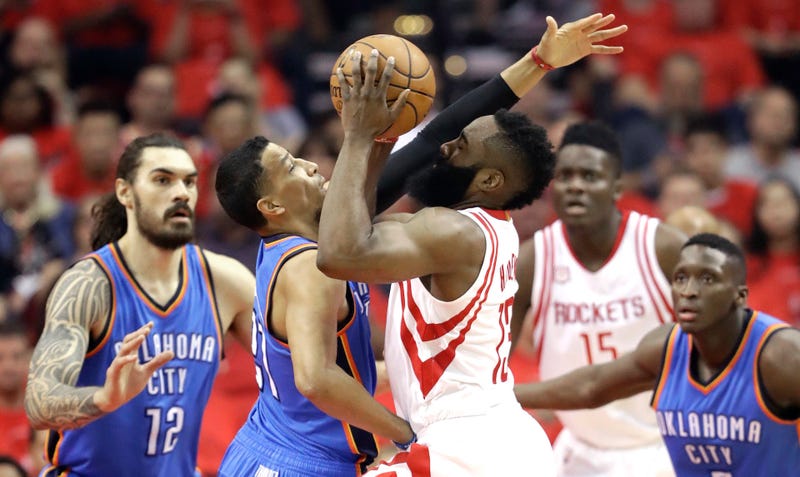
The Houston Rockets won Game 5 over the Thunder tonight, shooting their way out of a handful of Russell Westbrook-induced holes and taking a close one, 105-99. Much like the entire series, the game was excruciating to watch and the Thunder’s brief flickers of life did little to stave off the feeling that they were inevitably going to break themselves trying in vain to stop the Rockets from getting to the line and teeing off on open threes. Houston won, as they should have, for they are the better team.

For a series headlined by the two biggest stars of the regular season, Thunder-Rockets was defined by the supporting casts. The Rockets were series favorites because they have more than one player who can score, yet the gradient between the two teams looked even more stark than many projected it would be. Andre Roberson was nigh unplayable for long stretches due to his crippling inability to make shots and Victor Oladipo proved unable to do much more than throw the ball to Russell Westbrook at the top of the key and miss the odd shot here and there if called upon. The less said about the Thunder’s heinous bench unit, the better (aside from this: Alex Abrines is delightful. He also should not be a playoff team’s sixth man right now.)

On the other side of the aisle, the Rockets played a bench backcourt of Eric Gordon and Lou Williams, both of whom can hit from three, handle the rock, and, crucially, helm the offense without it turning into a massive pile of shit. The Rockets’ 105 points tonight were their lowest of the series by a good deal, and they won thanks to Williams and Patrick Beverley as much as anyone else.

James Harden didn’t have a great game shooting but he doesn’t have to for the Rockets to win. As he is wont to do, he put roots down at the line and went 16-for-17. At one point, the officials called Harden out for his cynical electioneering for foul calls (where he wraps his defenders up while he has the ball), but he stayed on his bullshit and scored 34 despite making just eight shots.


Elsewhere, Nene got the better of Steven Adams all series long and Beverley did a truly admirable job on Westbrook. The road to Westbrook shooting 37.3 percent on 29.5 shots per game ran straight through Beverley. A combination of high pressure from Beverley, Ariza, or Gordon on top of a team effort to crash down on Westbrook on his drives worked out well for the Rockets, even if Russ got his. Russ always gets his regardless of the outcome.

To blame Westbrook’s occasionally jaw-dropping yet ultimately inefficient series on hardwired selfishness or hubris seems like a hollow criticism. The Rockets were the superior team, tip-to-tail, which is not something Russell Westbrook could have overcome, even though he scored oodles of points. The Thunder are a haphazardly constructed team that relies on Westbrook for so much, and when he shoots his team out of games, they only tend to ever be in those games in the first place because Westbrook shot them there. OKC was -18 in the six minutes were Russ sat and they only had a lead to lose because of his spectacular 20-point third quarter.

Towards the end of Game 5, when Westbrook was completely spent and his legs looked like pudding, the Thunder’s offense was a sad mess. He’d get to the rim but lack the oomph to dunk or score easily, watching as his shots clanked short. It did not help that OKC’s best non-guard scorer was unplayable because he’s a matador on defense.

In contrast, the Rockets only got better at the end of games. Houston was +50 in the five fourth quarters of this series, winning every single one by at least eight. This says as much about their depth as it does about James Harden’s individual brilliance. Mike D’Antoni has designed an ideal offense for Harden’s passing and shooting talents and Harden executes on it perfectly. Nobody else gets the kick-out pass out faster than Harden when a defense collapses. He’s got legions of shooters and he knows how to find them. Unfortunately, he also knows exactly how to get to the foul line, and Houston were suited for the ugly anti-basketball that swallowed up the end of Game 5. That’s primarily frustrating because Harden is such an exciting player on all the plays where he’s not fishing for fouls. I want to see him navigate the pick-and-roll, not play tug-of-war with Roberson’s arm.

Either way, the Rockets advanced out of a series they should have and the Thunder’s very loud season ended with a whimper. It was ugly and it turned out like it was supposed to. Russell Westbrook went down swinging and James Harden will (probably) get a shot at Kawhi Leonard as his reward.


With two minutes and 12 seconds left in the San Antonio Spurs’ 116-103 victory over the Memphis Grizzlies, both coaches unloaded their benches. This is normal procedure during a playoff blowout, which each coach hanging on for a few minutes longer than usual, juuuuust to be sure. You can never be too cautious.

The difference in Tuesday’s game from a normal, run-of-the-mill blowout is how we got there. Only two and a half minutes prior, Memphis was surging and cut San Antonio’s lead to 102-97. Then, the Spurs rattled off a 12-0 run that effectively ended the game and triggered both coach’s closing lineups, one that sent the Memphis stars headed to the bench with their backs to the wall, and San Antonio’s contemplating the importance of finishing this series off in Memphis in Game 6.

Throughout these playoffs, this season, and even the past few years, we’ve seen huge leads evaporate in minutes. But the flip side is an obvious one: teams can grow them in moments, too, and San Antonio is a perfect example. They’re the Spurs, coached by the league’s consensus best coach and still geared to show up for a death blow when the time comes. Once the clock ticked under five minutes, something clicked in for San Antonio. After that happened, it was over.

This series took a sharp left turn when it shifted back to Memphis. For two games, the Spurs were exactly who we thought: a team that isn’t spectacular, isn’t sensational, but is consistently better than whomever they’re playing.

Once the Grizzlies were in their home confines, though, everything changed. They took Game 3 rather handily, and Game 4 might have been the game of the year so far when it ended on a Marc Gasol buzzer beater. But Memphis still cannot guard Kawhi Leonard, and that bit them once again.

Leonard dropped 28 points on 9-of-16 shooting, with six assists and a telling plus-19 while on the court. A bench lineup featuring him, LaMarcus Aldridge, Pau Gasol, and Patty Mills (20 points, plus-22) annihilated Memphis. Leonard’s stats could have been gaudier, but there were times where he basically sat at the half-court line, drew a defender out past the three-point line, and allowed his teammates to play four-on-four basketball. The extra spacing tends to work out, and their 53-percent shooting and 50 percent from downtown tells you all you need to know.

The Grizzlies aren’t friendly at home and they certainly don’t give up easy. But they would be wise to take a lead into “winning time” in the fourth quarter, and figure out something, anything, that could potentially turn Leonard into another player, not a superhuman force.

Otherwise, their season won’t be continuing on past Thursday’s game.


Still weak and lacking his usual energy after a bout with food poisoning, Gordon Hayward leaned on his teammates. They came up big.

Hayward scored 27 points, Utah controlled the paint and the Jazz beat the Los Angeles Clippers 96-92 on Tuesday night to take a 3-2 lead in their first-round playoff series.

"It was good I got some open looks early," said Hayward, who missed most of Utah's win in Game 4. "I was definitely tired out there. There was points in time where I didn't have legs. I'm pretty tired and thankful we have a couple days off."

The Jazz made five 3-pointers in the fourth quarter, including three by Rodney Hood, who finished with 16 points.

Joe Johnson hit two huge shots in the fourth, continuing his timely shooting against the Clippers.

"We are kind of growing up in the moment," said Johnson, one of three veterans brought in to balance Utah's inexperience. "These guys have never been in this situation. We have to go home with a business mindset and not be overconfident but confident enough. This has to be our Game 7 in Game 6."

Chris Paul's 3-pointer drew the Clippers within two with five seconds left. After George Hill hit two free throws, Paul struggled getting the ball under control near the sideline and couldn't do anything as time expired. He slammed the ball in frustration.

"They made the winning plays down the stretch, and therefore we lose," Paul said.

Paul led the Clippers with 28 points and J.J. Redick added 26 with injured star Blake Griffin watching from the bench, his right foot encased in a black walking boot.


"Chris got tired early," Clippers coach Doc Rivers said. "Without Blake in the first seven minutes, Chris is the only ballhandler on the floor, and that's too hard. That hurt our offense, so we have to make an adjustment there."

The Jazz can clinch the series with a victory in Game 6 on Friday night in Salt Lake City.

"We still haven't done anything yet," Utah coach Quin Snyder said. "We're competing though, and I like that."

The Clippers rallied from an 11-point deficit early in the fourth to tie the game. They made 12 of 15 free throws in the final period, but never managed to take the lead.

Paul and Hayward were called for double technical fouls with 40 seconds to go. Paul had already pushed Hayward in the back after they got tied up scrambling for a rebound that Hayward secured in front of Utah's bench. Hayward made both shots for a 90-85 lead.

"That was huge," Johnson said.

Neither team shot well, but the Jazz were better at most everything else. They owned a 34-28 edge in the paint, and the team that has done so has won each of the first five games in the best-of-seven series.

Utah outscored the Clippers on second-chance and fast-break baskets.

The Clippers clawed back with an 11-0 run in the fourth featuring five straight free throws by Redick and two consecutive 3-pointers from Paul that tied the game at 69-all.

The Jazz regrouped to take a 77-69 lead. They ran off eight straight, capped by Haywood's 3-pointer after the Clippers' defense shut down Hill inside and forced him to pass out to the perimeter with the shot clock winding down.


A bill expected this week in the U.S. House of Representatives would weaken a Food and Drug Administration rule governing e-cigarettes and represent a major victory for the $4.4 billion U.S. vaping industry.

The bill, from Republican Representative Duncan Hunter of California, would reverse the Obama administration's "Deeming Rule" which deems e-cigarettes to be tobacco products, subject to the same strict regulations governing traditional cigarettes. E-cigarettes heat nicotine-laced liquid into vapor but do not contain tobacco.

Hunter's bill, which was reviewed by Reuters, would exempt vaping devices from many of those rules, including a requirement that new products be reviewed and authorized by the FDA before being sold. E-cigarette makers say the process is too expensive and would prevent smokers from gaining access to the products.

The bill adds momentum to a series of legal and legislative efforts by tobacco and vaping companies to derail the FDA rule, though it is unclear how much support it will garner.

The move comes as President Donald Trump's administration is cutting regulations across the board and as Congress is poised to confirm Dr. Scott Gottlieb to lead the FDA. Gottlieb, who held a financial interest in the vape shop Kure, said e-cigarettes in certain circumstances may be a good alternative for smokers.

A separate plan from Republican Representative Tom Cole of Oklahoma and Democrat Sanford Bishop of Georgia would exempt thousands of vaping devices currently on the market from FDA approval. The Cole-Bishop proposal is expected to be attached as a rider to Trump's spending plan, which could be voted on as early as this week.

Hunter's bill would go further, bringing the entire regulatory process to a halt.

"Cole-Bishop is like gaining the inch, and Hunter's legislation the yard," said Joe Kasper, Hunter's chief of staff.

The FDA rule, which went into effect on Aug. 8, requires that any product introduced after Feb. 15, 2007, be submitted to the FDA for review within two years. Products that were on the market prior to that date are grandfathered and do not require premarket authorization.

The FDA said it does not comment on proposed or pending legislation.

Big tobacco companies such as Altria Group Inc and Reynolds American Inc see vaping products as a promising business line and have lobbied alongside their smaller e-cigarette counterparts against the rule.

"We believe that regulation should promote innovation of potentially less risky tobacco products," said David Sutton, a spokesman for Altria.

To that end Hunter's bill would formally incorporate the concept of harm reduction into the FDA's mission by requiring it to support less-dangerous nicotine delivery products. Those philosophically in favor of harm reduction argue that by promoting products considered less harmful than cigarettes, the overall public health will benefit.

Opponents fear that e-cigarettes are dangerous products that could be used by tobacco companies to addict a new generation of children to nicotine, and, they fear, to cigarettes.

"While we're always going to have some concerns about kids accessing either cigarettes or vaping pens, that should not motivate the federal government to go in the complete opposite direction and say nobody can have them," Kasper said.


The U.S. government's costs could increase by $2.3 billion in 2018 if Congress and President Donald Trump decide not to fund Obamacare-related payments to health insurers, according to a study released Tuesday by the Kaiser Family Foundation.

The payments amount to about $7 billion in fiscal year 2017 and help cover out-of-pocket medical costs for low-income Americans who purchase insurance on the individual insurance exchanges created by the Affordable Care Act, often called Obamacare.

Trump has threatened to withhold the payments to force Democrats to the negotiating table on a healthcare bill to replace Obamacare.

He has also said he will fund the subsidies if Democrats agree to funding for his proposed border wall with Mexico as part of efforts to pass a government funding bill this week and avert a shutdown. Democrats have rejected the conditional offer.

If no deal is made, parts of the federal government will shut down at 12:01 am on Saturday.

The payments are the subject of a pending Republican lawsuit that was appealed by the Obama administration and put on hold when Trump took office.

The government could save $10 billion by revoking the payments, Kaiser said. But insurers that remain in the market would have to hike premiums nearly 20 percent to cover their losses, Kaiser found, so the government would have to spend $12.3 billion on tax credits to help pay for Americans' premium costs - a net increase of 23 percent on federal spending on marketplace subsidies.

The projection assumes that insurers remain in the marketplace next year. Health policy experts have said without the payments, many insurers could not afford to stay in the market and will likely exit, which would leave some U.S. counties without an insurer.

Aetna (AET.N), UnitedHealth Group Inc (UNH.N) and Humana (HUM.N) have already exited most state exchanges for 2017 and said they will do so next year as well.


Pregnant women should get their blood pressure checked at each prenatal visit to screen for preeclampsia, a potentially fatal complication that can damage the kidneys, liver, eyes and brain, new U.S. guidelines say.

While many doctors already monitor blood pressure throughout pregnancy, the U.S. Preventive Services Task Force (USPSTF) updated its guidelines for the first time since 1996 to stress that screening at every visit can help doctors catch and treat preeclampsia before it escalates from a mild problem to a life-threatening one.

“Preeclampsia is one of the most serious health problems affecting pregnant women,” task force member Dr. Maureen Phipps, a women’s health researcher at Brown University in Providence, Rhode Island, said by email.

“Because this condition is common and critical, the Task Force offers two separate recommendations to help women lower the risk associated with preeclampsia - screening for preeclampsia is recommended for all pregnant women, and women at high risk of developing the condition can take low-dose aspirin to help prevent it,” Phipps added by email.

The screening recommendations, published on Tuesday in JAMA, apply to women without a history of preeclampsia or high blood pressure. Separate guidelines advise low-dose aspirin after the first 12 weeks of pregnancy for women with a history of elevated blood pressure. (bit.ly/2oIwP5B)

Preeclampsia can progress quickly, and typically develops after 20 weeks of pregnancy. Blood pressure screening earlier in pregnancy can show normal results for women who go on to develop preeclampsia.

In addition to elevated blood pressure, women with preeclampsia may also have excess amounts of protein in their urine, as well as swelling in the feet, legs and hands.

Women may suffer from stroke, seizures, organ failure and in rare cases, death. For babies, complications include slower growth inside the uterus, low birth weight and death.

Risks for preeclampsia include a history of obesity, diabetes, kidney disease, lupus or rheumatoid arthritis, as well as a mother or sister who has experienced the condition.

Because the risks of preeclampsia increase with age, women may be able to lower their chances of developing this complication by having babies sooner, said Dr. Dana Gossett, an obstetrics and gynecology researcher at the University of California, San Francisco, and co-author of an accompanying editorial in JAMA.

“Beyond that, it is also important to ensure that all health problems are well managed prior to pregnancy,” Gossett said by email. “High blood pressure should be under good control, other diseases like kidney disease or lupus should be well controlled, and women should try to be close to their ideal body weight prior to conception.”

Checking blood pressure at every prenatal visit can help prevent complications for mothers and babies alike, said Dr. Martha Gulati, chief of cardiology at the University of Arizona College of Medicine in Phoenix and author of a separate editorial in JAMA Cardiology.

“This is something that should be provided to every woman as part of preventive care,” Gulati said by email. “We will save lives and prevent complications and death in pregnant women with this simple, cost-effective” test that doesn’t take much time.

The Cassini spacecraft is going where no ship has gone before: On Wednesday, it begins a series of dives into the space between Saturn and its magnificent rings. The maneuver — a series of 22 orbits that will bring Cassini increasingly closer to Saturn’s surface before crashing into it — is called the spacecraft’s “grand finale.” And to mark this final journey, Cassini is being honored with a Google Doodle.
Over its last 13 years in orbit, Cassini has had an amazing run studying Saturn and its moons. Here’s what the spacecraft has taught us so far — and why its final mission may be its most spectacular yet.

In its last days, Cassini keeps generating fascinating insights

Cassini — named after the 17th-century astronomer Giovanni Cassini — launched from Cape Canaveral in October 1997 in collaboration with the European Space Agency. When it launched, we were still a few months away from Bill Clinton’s damning “I did not have sexual relations with that woman” remark. Harry Potter had not yet been published in the United States.
From there, it took Cassini and the Huygens lander (destined to touch down on the moon Titan) seven years to reach Saturn. Once it arrived, it started to make impressive discoveries.
On Titan, Cassini and Huygens revealed surprisingly Earthlike geographic features and great lakes of liquid natural gas on the moon’s surface that outweigh all the oil and gas reserves on Earth. Cassini found evidence of an underground ocean on the moon Enceladus. It learned how new moons could form out of Saturn’s rings. And it has taken detailed, beautiful photographic surveys of the planet’s rings and surface features.
 NASA/JPL/Space Science Institute
Nearing the end of its life, Cassini is still producing scientific discoveries at a fast clip.
Earlier in April, NASA announced that the spacecraft had found the most compelling evidence yet that the ocean underneath Enceladus could contain life.
Previously, the Cassini spacecraft has observed jets of water containing organic chemicalsstreaming from Enceladus. This latest finding adds a key ingredient for life to the mix: hydrogen. The presence of hydrogen in the jets makes NASA scientists suspect there are geothermal geysers on Enceladus’s ocean floor. Like the geothermal vents deep within Earth’s oceans, these could be home to microbes that use the chemical energy of hydrogen and carbon dioxide to produce methane and energy for life.
Now Cassini is beginning a series of harrowing orbits that bring it into the space between Saturn and its rings — a region no spacecraft has been before. When Cassini is in the inner rings, it will finally be able to take the measurements that will aid in calculations to determine the mass of the rings.

Why NASA is diving into the space between Saturn and its rings

On Wednesday, Cassini begins a maneuver that is unprecedented in the history of spaceflight: It’s adjusting its trajectory to bring it inside the 1,500-mile-wide gap between Saturn and its rings for 22 orbits.
This is what that dive will look like from Cassini’s perspective.
In these illustrations, the blue lines represent each of the 22 orbits getting closer and closer to the atmosphere of the giant planet. The red line represents the final orbit, which will end with Cassini crashing into Saturn’s atmosphere.
 NASA / JPL
 NASA / JPL
In this space, Cassini will be able to take new measurements to better determine the total mass of Saturn’s rings. NASA already knows the mass of Saturn plus its rings. Getting closer to the planet will allow Cassini to take its mass without factoring in the rings. That information will help scientists better understand how the rings formed (which in turn can help them understand how all the planets formed from rings of material around the sun).
The orbits will also produce the closest-ever observations of Saturn’s clouds — yielding incredible images.
It will be a thrilling journey, but also a perilous one. NASA has saved the ring-grazing orbits for Cassini’s finale in part because they are dangerous. The orbits will bring Cassini close to debris and rocks that could take it offline.

“We’re going out in a blaze of glory”

This artist’s concept shows an over-the-shoulder view of Cassini making one of its grand finale dives over Saturn.
 NASA / JPL
Come September 15, Cassini will crash into Saturn, having spent all of its fuel. But the death dive isn’t just for fireworks. If the spacecraft doesn’t plunge into Saturn’s atmosphere, it runs the risk of potentially contaminating one of the planet’s moons with debris and microbes from Earth.
And there’s no turning back: “The spacecraft is now on a ballistic path,” Earl Maize, a Cassini project manager, said in a press statement, meaning that the spacecraft’s path is shaped mostly by gravity, not by thrusters. “Even if we were to forgo future small course adjustments using thrusters, we would still enter Saturn’s atmosphere on Sept. 15 no matter what.”
Cassini’s dramatic finale is also a last chance to squeeze some more insights out of the 20-year-old spacecraft. As it descends into Saturn’s atmosphere, “several of the instruments will be on,” including the mass spectrometer, Preston Dyches, a NASA spokesperson, says. This instrument essentially can “sniff” the atmosphere and determine the chemical compounds it’s composed of.
On April 12, days before it made its final flyby of Titan, Cassini captured this incredible image of Earth shining through Saturn’s rings, as if to remind us of how far it’s come since beginning its journey. From Saturn, we’re just a tiny bright speck in the darkness.
When Cassini finally goes offline in September, it will die doing what it’s been doing all along: exploring.
| Copyright © 2013 24/7worldnews